Specialised property searches in Scottish conveyancing

While standard searches remain the foundation of Scottish conveyancing , the landscape of additional searches is changing. Where essentials like legal reports and property enquiry certificates provide crucial information for every transaction, specialised property searches in Scotland’s property transactions are increasingly the realm of standard practice – and conveyancers today need to be proficient in the expanding types of specialised searches.

Community interest checks

One of the biggest changes to specialised searches is the increased need to check the Register of Community Interests in Land (RCIL) and Register of Applications by Community Bodies to Buy Land. In 2016, the Community Empowerment (Scotland) Act extended the Community Right to Buy across the entire country, to cover urban and rural properties alike and, in 2018, added the option for communities to register interest in purchasing abandoned, neglected or detrimental land as well.

These registers record community bodies’ interests in buying property or land, and when one on the register goes on the market, it activates that group’s right of first refusal. Adding to the precariousness of these registers, landowners aren’t always made aware when such interests are registered against their property. Purchasers naturally want to know local communities do not have their eyes on the property they intend to buy, so a check of both registers is now, in Scotland’s countryside and cities, a completion requirement.

Coal mining reports

Scotland’s deep-mining industry ended in 2002 when Longannet in Fife closed. But mining’s legacy continues to influence property transactions – after all, coal mining affected swathes of Scotland, so coal mining reports are important for properties in or near former mining areas.

These reports provide crucial details about mining activity and highlight any geological weaknesses or subsidence claims – information that could significantly affect a property’s value and insurability.

A coal mining report also provides information on:

  • mine entries within 20 metres of a property’s boundaries
  • gas emissions from coal mines
  • other coal mining hazards reported in the area
  • plans for future coal mining in the area

In particularly sensitive cases, enhanced ground stability reports offer additional expert interpretation on subsidence risks.

Environmental considerations

Once on the periphery of property transactions, environmental concerns are now very much forward into buyers’ minds. Environmental reports now offer sophisticated risk assessments based on a property’s history, highlighting contamination risks along with other environmental factors, like flooding, ground stability, radon levels and nearby energy or infrastructure projects.

Most environmental reports are designed to be practical and easy for the buyers to understand. They are marked with clear passed or referred status to highlight potential issues and also share valuable professional opinions and recommendations to guide both practitioners and clients.

Other specialised searches worth considering

Depending on a property’s location and characteristics, several other specialised searches might be warranted:

You can consult the Register of Sites of Special Scientific Interest (SSSI) when there could be protected plants, animals, habitats, or geological feature on a property – it reveals whether a property is affected and what specific restrictions apply.

If there is a question over rights of way, a specialised Scotways search can identify whether a property is affected by public access rights that might impact its use or value.

For properties with potential historical significance, checking listed building status through Pastmap provides information beyond what appears in standard property enquiry certificates and also covers scheduled monuments and other heritage designations.

The Forestry Commission has interactive mapping tools to aid investigations of the Commission’s schemes or dedication agreements, though interpreting the implications still requires professional judgement.

Recent legislation has introduced further requirements to confirm that status of parties involved in a property transaction. Depending on the nature of the transaction, searches in the Register of Overseas Entities or the register of Controlling Interests in Land may be required.

The expansion of specialised searches reflects the increasing complexity of property rights and regulations in Scotland. While this may seem to add layers to the conveyancing process, these searches ultimately protect all parties involved in transactions.

For conveyancers, the challenge lies in knowing which specialised searches are truly necessary for each transaction while avoiding unnecessary costs for clients. To achieve this, your firm needs to stay up to date with evolving requirements and exercise sound professional judgement based on each property’s unique circumstances. As the landscape continues to evolve, incorporating these specialised searches thoughtfully into practice helps ensure we deliver the comprehensive due diligence clients expect and deserve.

Share this post on social media

Our services

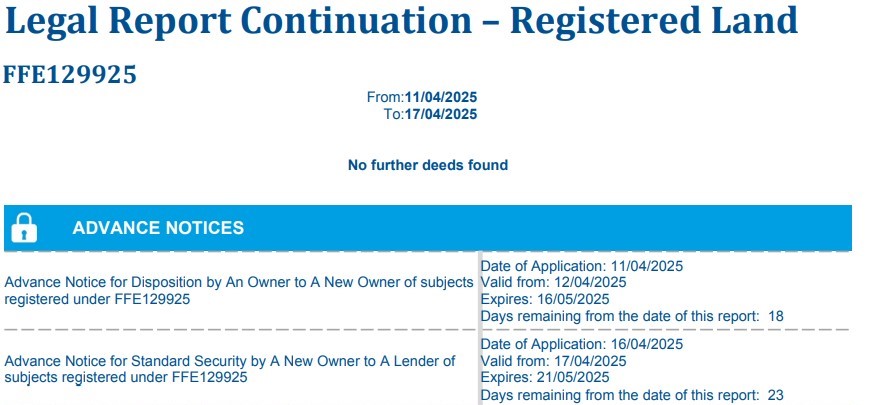
Change to Advance Notices shown on Legal Report Updates

Following feedback from customers, we are making a change to how we show outstanding Advance Notices (ANs) on our Legal Report Updates.


Our current practice is to show any AN on a Legal Report (LR) if the AN was registered or recorded in the period that LR covers. We apply the same principle for Legal Report Updates (LRU), so if an AN was submitted prior to the LRU it will have been shown on the original LR so we don’t currently show it on an update.

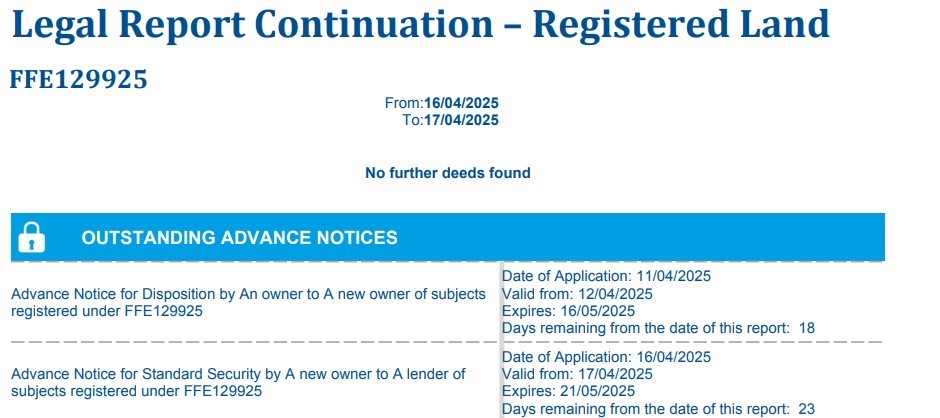
It’s not uncommon to get a follow up query if we haven’t shown an active AN on a LRU even if it has been shown on the original LR. We’d like to reduce this confusion, report the position more clearly and allow users to rely solely on the LRU without having to refer back to the original LR to see all outstanding ANs.

When will this change take effect?

Our change, which is effective in the next few weeks, relates to the LRU. We will continue to show ANs on a LR if they are registered or recorded in the period that LR covers, however when we provide an LRU, we will report from the date of the original LR for any changes to the title, additional deeds submitted etc (as we currently do), in addition we will show all outstanding ANs, including any that might have previously been shown on a LR.

This will provide a clearer current position and will also reduce the need to refer back to an original LR.

Current Format
New Format


Support & Feedback

We hope that you agree that this updated process will make the position on ANs clearer at the point of settlement use but of course if you have any issues or feedback we’d be delighted to hear from you.

For further information please contact the Millar & Bryce Customer Relationship team who will be happy to assist you: relationship@millar-bryce.com

Share this post on social media

Our services

Property searches in Scottish conveyancing

Property searches are a cornerstone of Scottish conveyancing. No property transaction can complete without searches of the Land Register, Register of Inhibitions, Companies House, even the outgoing Register of Sasines, until all Scottish property is registered on the Land Register. Since the 19th century, professional searchers have handled the technical heavy lifting, but conveyancers need to understand what’s needed – and why – to shape our daily practice. The reality is that thorough searches and enquiries protect both our clients and our firms.

The golden rule of property searches is to order early. By getting ahead of the game, there is breathing space to address whatever comes up. There are, of course, those searches that need to be current at the time of transaction, ordered immediately before settlement. Even then timing really is everything to avoid adding more stress to an already intense situation for clients and Millar & Bryce are experts at delivering these time sensitive searches, early on the day that you need them..

Navigating registration status

There are two paths for searches in Scotland, each depends on whether you’re dealing with property already in the Land Register or if it’s still in the Sasine Register, yet to be added to the Land Register.

Unregistered properties

Unregister properties need a legal report (unregistered), so they can be added to the Land Register. In a legal report, you describe the property so it can be identified on the Sasine Register, which, in this case, is the source of the search.

The legal report (unregistered) response will detail:

  • all relevant common entries within a 40-year Sasine search period
  • the prescriptive progress of title being an unbroken chain of titles going back at least ten years
  • any outstanding securities in that ten-year period
  • any discharges recorded in the preceding five years
  • any alienations from the property description
  • whether the property is already subject to registration in the Land Register
  • any valid advance notice recorded to protect an intended deed (not a transaction) between two or more parties for a 35-day protected period

Since the Land Registration etc. (Scotland) Act 2012 (LRE(S)A 2012) introduced no registration without mapping, all properties need to be on a plan that shows the boundaries match the title deeds as well as the OS map, cadastral map and that there are no conflicts with any already registered titles.

To make sure this happens, there are three levels of report, each delivering another level of information, but most practitioners choose the most comprehensive report, Level 3. As well as checking the maps, boundaries and other registered deeds, it identifies conflicts with existing cadastral units and provides an illustrative print showing the extent of the competition. It also discloses relevant information, including servitudes, real burdens and other registered interests, such as minerals.

Yes, they cost more, but the detail of level 3 plans can flag potential issues and alert you to mapping issues before submitting an application for registration – and if an existing deed plan is not suitable for registration, it is simple to get a new deed plan from Millar & Bryce that conforms to the Keeper’s deed plan criteria.

Registered properties

A legal report (registered) lays out the details on the title sheet or application record in the Land Register. Much more streamlined, legal report (registered) confirms or discloses:

  • changes to the postal address and current ownership details
  • outstanding charges affecting the property
  • leases or real burdens affecting the property
  • details of miscellaneous burden deeds or alienations registered after the current proprietorship or on the title sheet as a schedule of removals
  • valid advance notices entered in the application record

While a title number is technically enough for identification, using the full address does help prevent those awkward moments when similar numbers lead to confusion. It’s a small step that can prevent significant complications.

For both registered and unregistered legal reports, the seller’s conveyancer usually orders a continuation to cover the period between its arrival and the settlement of the transaction, so all the information is up to date at hand over.

Universal search requirements

There are standard searches for all transactions, specifically personal searches and property enquiry certificates. Personal searches check if there is anything that inhibits the person from selling, like bankruptcy, court notices. The property enquiry certificate (PEC) gathers information on the status of a property from local authority data sources and statutory registers, covering:

  • planning
  • building control
  • statutory notices
  • roads
  • water and sewerage
  • contaminated land

When buying property from a company, you should request a company search to scrutinise the information available on Companies House as well as more specific company checks

  • the register of charges to disclose outstanding entries and any adverse notices relating to liquidation, receivership, administration order, winding up or striking off
  • the register of insolvencies for all Scottish registered companies
  • the company file, to disclose the current directors and secretary (and registered office)

When searches raise red flags

Should search results reveal unexpected complications, the best approach is to take action quickly and share advice and practical solutions with the client. But this can only work effectively if the searches were ordered with plenty of time for those red flags to not derail the transaction – risk management is essential.

Managing the process

Balancing thoroughness with efficiency equates to successfully managing searches. While maintaining comprehensive records might not be the most exciting part of the job, it prevents oversights and helps justify actions if or when questions arise later. Early communication about potential issues generally leads to better outcomes than last-minute surprises.

Looking forward

As the profession continues to evolve, understanding search requirements remains crucial. While you can delegate the technical work to professional searchers, keeping an eye on the process protects both your clients and our practice.

By understanding the searches’ purpose and maintaining appropriate procedures, you can ensure they serve their intended protective function. After all, effective conveyancing combines technical knowledge with practical judgment. And while technology and registration systems may change, the fundamental need to understand what we’re dealing with remains constant. Staying alert to these requirements helps ensure we continue to serve our clients effectively while protecting our professional interests.


Share this post on social media

Our services

Millar & Bryce at 150: Property Excellence Past, Present & Future

Millar & Bryce at 150: Property Excellence Past, Present & Future is taking place on Wednesday 14th May at Dynamic Earth, Edinburgh.


Find out what will be shaping the Scottish property market in 2025 and beyond as industry leaders share their insights over a broad range of topics.

Millar & Bryce considers that this event represents five hours of continuing professional development activity, however each attendee must consult the rules of their individual accreditation scheme or professional body if they require confirmation. 


Full agenda below:


12 NOON

Registration & fork-buffet networking lunch

12:45PM
Welcome
Conference Host, David Lee

12:50-13:10PM:
A long and proud history of innovation: 150 years of Millar & Bryce
Richard Hepburn, Director Scotland, Millar & Bryce

13:10 – 13:30PM:
Serving the clients of today with honesty, authenticity and technology
Gary Donaldson, Operations Director & Lorna Kerr, Sales Director, Millar & Bryce

13:30 – 13:50PM:
Advancing into digital transactions: do we need to go faster?
Ann Stewart, Property and Professional Development Adviser, Shepherd and Wedderburn

13:50 – 14.10PM:
Sustainability. Navigating the Future, with Confidence
Chris Loaring, Sustainability Director, Landmark Information Group

14:10-14:40PM
Keynote: The Property Buyer of the Future: What You Need to Know
William Ullstein, CEO – UK, YouGov

14:40PM:
Coffee break & networking

15:05 – 15:30PM:
The Use of GenAI in Property Due Diligence
Yayoi Teramoto, Data Scientist, Landmark Information Group

15:30 – 15:50PM:
Bringing it all together
Mike Holden, Divisional Director of Growth, Landmark Information Group

15:50 – 16:25PM:
Panel discussion: a property sector fit for the 21st century
Jill Andrew, Partner, Connell & Connell, Chair of Edinburgh Conveyancers Forum | Alan Cumming, Head of Sales & Financial Services, Rettie | Lyndsay Gowans, Director, DHKK Chartered Surveyors | Mike Holden, Divisional Director of Growth, Landmark Information Group

16:25PM:
Closing remarks
Simon Brown, CEO, Landmark Information Group

On closing we will head back to the Ozone & Stratosphere conference space for drinks & canapes, whilst taking in the stunning views of Arthur’s Seat and the Salisbury Crags.

Share this post on social media

Our services

What does the completed Land Register look like and how does that affect your firm?

In evidence to the Economy and Fair Work Committee in October 2024, the Keeper noted that total land mass coverage – a composite of titles registered, in‑progress, and unlocked from Sasines – had surpassed 95%. As of October 2025, RoS reports 96.0% total coverage and 88.0% progress toward functional completion. Within that composite, the share of Scotland’s land mass actually registered was around 55–56% across 2024–25, reflecting steady transition from Sasines to the map‑based Land Register and continued backlog reduction.

As of March 2026, the Registers of Scotland reports that total land mass coverage has reached 96%. The Land Register now includes 60.2% of Scotland’s land mass, with significant strides made in processing outstanding applications and enhancing transparency through the Unlocked Sasines project.

It sounds impressive, especially when you remember this ambitious project, which went live in 1979 as a consequence of the Land Registration (Scotland) Act 1979, is navigating an entire nation away from a complex property ownership recording system – the Sasine Register – that’s been in place since 1617.

Nonetheless, this figure, like all statistics, needs context. To reach this figure, Registers of Scotland (ROS) calculated the total land mass coverage by adding

  • land in the Land Register (60.2%)
  • current casework in progress (4.2%)
  • data unlocked through Indicative Sasines – previously known as unlocking Sasines (31.6%)

When we take all this into consideration, the figures tell a more nuanced story and presents an interesting landscape for conveyancing professionals to navigate.

ROS is also using the Functional Completion approach, which focuses on properties most likely to transact, to pave a more efficient way of reporting the pathway to completing the register. Functional Completion of the Land Register (rather than actual completion) is seen by ROS as being delivered when most land and property that transacts regularly is on the Land Register. Properties unlikely to transact regularly include large estates and social housing. But, for now, land and properties that rarely or may never sell are excluded from the Functionally Complete calculations, which suggests the land in the Land Register could, in fact, be lower than 60.2%.

As conveyancers, in day-to-day practice, we should err more on the side of caution and recognise that only 60.2% of Scotland’s land mass is listed in the Land Register – still a notable achievement – and that we need to be alert to the challenge of at least 40% needing extra attention.

The reality is that while we move toward comprehensive land registration, many transactions will continue to involve unregistered land. This means firms still need expertise in sasine titles as well as Land Register proficiency. We are not yet in a position to pack away our sasine textbooks!

Managing the challenges

With 3% of Scotland’s property – that’s over 80,000 applications, with the older case from January 2019 – currently as open cases, there are a lot of people still waiting for the protection of the Keeper’s warranty, which they will only have when that registered title comes through.

ROS knows this is a challenge, so it created an expedited application process for pending transactions that meet certain criteria. This is keeping the industry moving in some cases, but not all applications meet the ROS criteria.

When properties move from the Sasine Register to the Land Register, there is no longer any theoretical need to check or rely on the Sasine Register. However there have been instances of standard securities not being discharged during first registration. The risk here is that once a property moves to the Land Register, the conveyancer’s normal practice is to check only the Legal Report over the Land Register title or pending applications, not the historical Sasine Register, so if a party in the first registration has failed to satisfy their obligation to discharge an outstanding security, then old securities might be lurking in the background, invisible to conveyancers working on later transactions.

As a business, you can take steps to avoid this. When dealing with first-registration properties, if the first registration is pending, you can request both a registered legal report and an unregistered legal report over the sasine title to build a complete picture. This dual-report approach means you can identify any historical securities that might otherwise be missed, ensuring cleaner titles and reducing risk for all parties involved. When presenting this option to clients, it’s worth explaining that the additional cost of an unregistered legal report is often justified by the security it provides and potential issues it can uncover.

Understanding Indicative Sasines

The Scotlis Indicative Sasines (previously known as Unlocking Sasines) recognises the current low land register coverage and shows ROS’s commitment to try and introduce transparency of ownership from the, sometimes complex, sasine register – and it accounts for 31.6% of the quoted 96% Land Register completion. However, while the project “helps to indicate the likely ownership of areas not on the Land Register,” it does not provide absolute certainty of ownership. It can provide a useful bridge between the old and new systems and it certainly makes historical information more accessible. However, as a research tool, it is useful only as part of an overall toolkit for property investigation as you try to navigate those complex sasine search sheets. A final word of caution on Indicative Sasines, remember this is not a property register, it’s not a means to confirm ownership and boundaries with a 100% accuracy and it’s not a comprehensive source of all sasine titles.

How we can move closer to Land Register completion

While it continues the intimidating job of getting all of Scotland’s property listed in the Land Register, RoS is trying to support the nation’s conveyancers. And it welcomes all the support we in the industry can offer – with all of us working together, while recognising realistically the current coverage of the land register, we can get to completion much sooner. Its success will depend on maintaining a practical balance between embracing new efficiencies while retaining traditional expertise and authenticity and transparency in reporting against progress.

Understanding the current nuances helps you provide better service to clients while managing risk effectively. For now, maintaining capability in both registered and unregistered land remains key to successful conveyancing practice.

Editorial note

All statistics, figures and market data presented in this blog are believed to be accurate as of 13th April 2026. Figures relating to Land Register coverage, functional completion, and progress, open casework volumes and turnaround times are updated regularly by Registers of Scotland and should be checked immediately prior to publication to ensure accuracy.

Sources

  1. https://www.millar-bryce.com/news/hidden-consequences-of-backlog-of-ros-open-casework
  2. https://www.ros.gov.uk/performance/land-register-completion/land-mass-coverage-in-scotland
  3. https://vr-bng.scottishparliament.tv/meeting/economy-and-fair-work-committee-october-30-2024
  4. https://www.ros.gov.uk/about/publications/finance/2024/annual-report-2023-24
  5. https://www.ros.gov.uk/about/publications/finance/2025/annual-report-2024-25
  6. https://www.ros.gov.uk/performance/land-register-completion/unlocking-sasines
  7. https://www.ros.gov.uk/performance/land-register-completion/functional-completion
  8. https://www.ros.gov.uk/performance/land-register-completion/unlocking-sasines

Share this post on social media

Our services

Aberdeen CPD Event: The Future of Conveyancing

Join the Millar & Bryce CPD Roadshow 2025 in Aberdeen. The third flagship CPD event of the year – The Future of Conveyancing 2025 – will take place on Tuesday 25th March at the Sandman Signature Aberdeen Hotel.

This year’s Aberdeen event will see the return of our seasoned experts, Carole Russell and Eric Willis as they discuss what the future holds for residential conveyancing in 2025 and beyond.  There will also be a panel where you can ask us your pressing questions.

Join us in the heart of the Granite City, in one of Aberdeen’s most historic buildings from 09:30AM and we’ll kick off the programme at 10:00AM, wrapping up by 12:30PM.

Full agenda below:

09:30AM:
Registration and networking breakfast

10:00 – 10:10AM:
Introduction
Welcome from Richard Hepburn, Managing Director at Millar & Bryce. 

10:10 – 10:40AM:
The Whole Picture – Will plans become less important?
Carole Russell, Technical Advisor

10:40 – 11:10AM:
What does the completed last register look like and how does it affect your firm
Gary Donaldson, Operations Director

11:10 – 11:30AM:
Tea and coffee break

11:30 – 12:10PM:
Rectification in the 2012 Act
Eric Willis, Project Manager

12:10 – 12:20PM:
Panel discussion and questions
Gary Donaldson, Operations Director
Carole Russell, Technical Advisor
Eric Willis, Project Manager
Iain Daniels, Information & Mapping Searcher

12:20PM:
Summary and final comments
Richard Hepburn, Managing Director

Share this post on social media

Our services

Glasgow CPD Event: The Future of Conveyancing

Event is full and registration is now closed.

Join the Millar & Bryce CPD Roadshow 2025 in Glasgow. The second CPD event of the year – The Future of Conveyancing 2025 – will take place on Tuesday 4th February at the voco® Grand Central Glasgow.

This year’s Glasgow event will see the return of key industry speakers Carole Russell and Eric Willis discuss what the future holds for residential conveyancing in 2025 and beyond.  There will also be a panel where you can ask us your pressing questions.

Join us at 09:30AM in the heart of Glasgow at this historic hotel and much-loved city icon from 09:30AM and we’ll kick off the programme at 10:00AM, wrapping up by 12:30PM.

Full agenda below:

09:30AM:
Registration and networking breakfast

10:00 – 10:10AM:
Introduction
Welcome from Gary Donaldson, Operations Director at Millar & Bryce.

10:10 – 10:40AM:
The Whole Picture – Will plans become less important?
Carole Russell, Technical Advisor

10:40 – 11:10AM:
What does the completed last register look like and how does it affect your firm
Gary Donaldson, Operations Director

11:10 – 11:30AM:
Tea and coffee break

11:30 – 12:10PM:
Rectification in the 2012 Act
Eric Willis, Project Manager

12:10 – 12:20PM:
Panel discussion and questions
Gary Donaldson, Operations Director
Carole Russell, Technical Advisor
Eric Willis, Project Manager

12:20PM:
Summary and final comments
Gary Donaldson, Operations Director

Share this post on social media

Our services

Edinburgh CPD Event: The Future of Conveyancing

We are excited to announce the return of the Millar & Bryce CPD Roadshow 2025,  launching with our first event in the heart of Edinburgh. CPD Edinburgh Event 2025:  The Future of Conveyancing 2025 will take place on Tuesday 21st January 2025 at Doubletree by Hilton, Edinburgh City Centre (34 Bread Street, EH3 9AF)

Following the success of our 2024 Millar & Bryce CPD programme, this year’s event will see the return of key industry speakers Carole Russell and Eric Willis discuss what the future holds for residential conveyancing in 2025 and beyond.  There will also be a panel where you can ask us your pressing questions.

Join us at 09:30AM to take in the the morning panoramic views of Edinburgh from the Penthouse Suite and we’ll kick off the programme at 10:00AM, wrapping up by 12:30PM. 

Full agenda below:

09:30AM:
Registration and networking breakfast

10:00 – 10:10AM:
Introduction
Welcome from Richard Hepburn, Managing Director at Millar & Bryce. 

10:10 – 10:40AM:
The Whole Picture – Will plans become less important?
Carole Russell, Technical Advisor

10:40 – 11:10AM:
What does the completed last register look like and how does it affect your firm
Gary Donaldson, Operations Director

11:10 – 11:30AM:
Tea and coffee break

11:30 – 12:10PM:
Rectification in the 2012 Act
Eric Willis, Project Manager

12:10 – 12:20PM:
Panel discussion and questions
Gary Donaldson, Operations Director
Carole Russell, Technical Advisor
Eric Willis, Project Manager
Iain Daniels, Information & Mapping Searcher

12:20PM:
Summary and final comments
Richard Hepburn, Managing Director

Share this post on social media

Our services

What the rest of the UK can learn from Scotland’s streamlined property transaction process

Landmark residential property trends report Q3 ‘24 – October 2024 originally published by Landmark Information Group

What makes the Scottish property transaction process more effective than our counterparts in England & Wales. 


Landmark’s Property Trends Report for Q3 2024 is now live, providing an in-depth analysis of developments in the residential sector. Richard Hepburn, Managing Director of Millar & Bryce, explores the current market trends presented in Landmark Information Groups’ Q3 property trends report.

In our latest quarterly Property Trends Report from parent company, Landmark Information Group, presenting July-September 2024 data on listings, Sold Subject to Missives, completions and registered sales, Scotland’s figures offer a valuable perspective in comparison to the rest of the UK. Completions were down just 13% in Q3 2024 vs Q3 2019 (the last ‘normal’ pre-Covid benchmark year), which contrasts sharply with England and Wales – where completion volumes were down 42% – indicating that Scotland’s streamlined transaction process working more efficiently. 

So why are property transactions more likely to be successful in Scotland?

Devolved matters; Scottish Parliament

Across the UK, the uncertainty over mortgage rates and the new Labour Government kept the brakes on the residential market. In Scotland, as land and property related matters are devolved to the Scottish Government, the implications from ongoing political unrest have had less of an impact.

Richard says, “Whilst some sellers and buyers in Scotland might have been holding off to see what beneficial changes the new UK Government will make the fact that some key levers in the property space are controlled by the Scottish Government (transaction taxes, first-time buyer incentives) means, we may not see the same profile of activity going forward.”

As prospective buyers paused ahead of the Budget in the hope of more favourable interest rates, residential listings remained high, and the presence of sub-4% interest mortgage deals started to create more seller and buyer confidence.

Continuing, Richard commented, “One other factor in the mix is the first new Labour Government Budget. Down South, there has been the sense that some buyers have held off to see if there are any property tax changes to come before acting. This might have lesser impact on us with property taxes set locally by the Scottish Government. The SDLT changes from Spring 2025 in England & Wales announced in the 30th October budget won’t impact Scottish buyers but it remains to be seen what changes the Scottish Government might announce in the 4th December Scottish budget.”

While the expected November 0.25% base rate interest rate cut to 4.75% has gone ahead, uncertainty remains with major UK lenders increasing mortgage rates and predictions that these will remain at this raised level for some time on the back of , with some measures in the October 30 budget .

Home Report

Earlier this year, Richard commented on the ‘dynamic’ of Scotland’s transaction end-to-end pipeline and market that allowed a more efficient transaction process with quicker turnaround times.

In Scotland, we have the well-established Home Report at the beginning of every listing process, mandatory under Scottish Government requirements. This also satisfies many of the up-front information requirements under the National Trading Standards Material Information rules that came into force in the Autumn of 2023. Their ask is simply to ensure that sufficient transparency is given on all ‘material information’ to prospective purchasers right at the start, avoiding them wasting time and money in considering a property that may not be suitable for them. These extend to items not typically included in the Home Report currently such as flooding, property rights (ie. access) and impact of coal mining. Flooding is a good example of a forward-looking risk which is not covered off in the current transaction process in Scotland but may in the future be impacted by the effects of climate change for example.

Richard continues: “To further compliment the current Home Report, Landmark Scotland has developed a Supplementary Report with the aims to further close the gap in satisfying the Material Information requirements, providing the additional, property specific, information needed to comply with parts B & C of the rules”.

Whilst overall we don’t have the same transaction delays as in England and Wales, with the Home Report already recognised by National Trading Standards as being pretty close to the levels of up-front transparency they require, this supplementary information completes the picture.

Q4 Insights

Richard commented, “As economic factors continuing to stabilise and Scotland’s efficiencies in home buying and selling make for a more streamlined transaction process – the outlook for Q4 and into 2025 is looking more positive. A healthy residential property market is a proven factor in improving the economy overall.”

Download our report

For more in-depth insights, check out our Q3 2024 Residential Property Trends report today.

Share this post on social media

Our services

Festive Opening Times 2024

Over Christmas and New Year, our office hours will vary from usual. Please see our Christmas opening times below:

Wednesday 25th December: Bank Holiday: Office closed

Thursday 26th December: Bank Holiday: Office closed

Wednesday 1st January: Bank Holiday: Office closed

Thursday 2nd January: Bank Holiday: Office closed

Millar & Bryce will operate normal office opening hours on all other working days over the festive period.  Should you have any questions, please do not hesitate to contact our Customer Relationship team at relationship@millar-bryce.com
 
We wish our customers and partners a Merry Christmas, and a Happy New Year. We look forward to our continued partnership in 2025 and celebrating our incredible 150th milestone year.

Login